
Most UK Engineering Salary Benchmarks Are Missing One Critical Thing: Local Market Reality
Recruitment is full of salary guides.
Every year, new reports are published showing the “average” salary for engineers across the UK. They’re downloaded thousands of times, shared across LinkedIn, and used by hiring managers to build budgets.
The problem?
Many of these figures don’t reflect what employers are actually paying in their local market.
They’re based on national averages, broad datasets and aggregated information that often ignores the biggest factor affecting engineering salaries:
Location.
The difference between published benchmarks and real hiring data
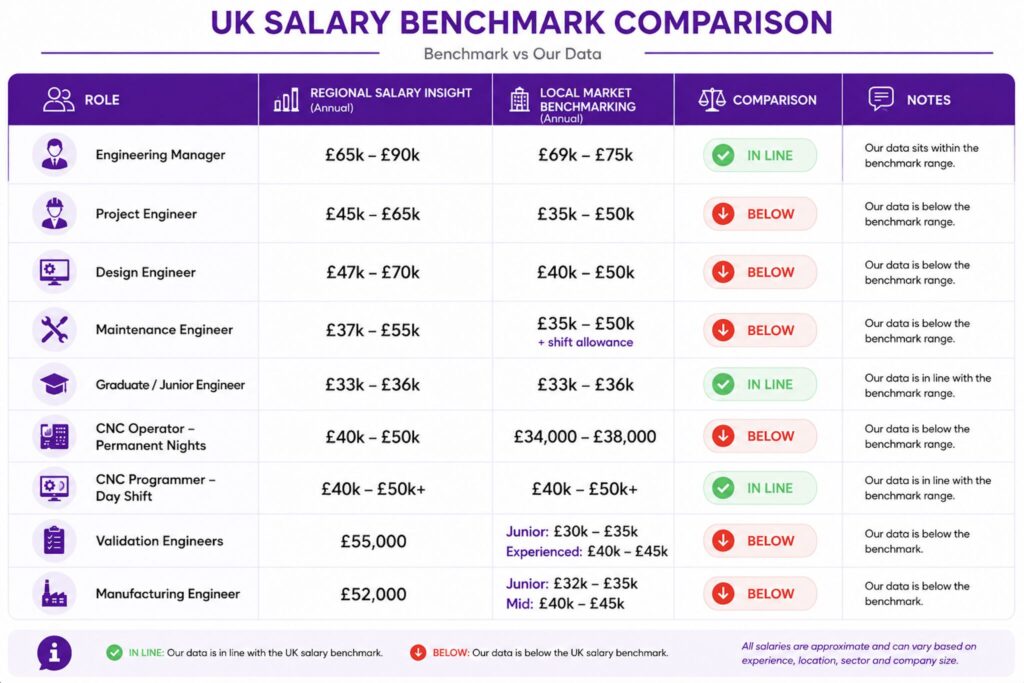
We recently compared national UK engineering salary benchmarks against the salaries we’re seeing across our local engineering market.
The results were eye-opening.
For several engineering disciplines, published salary data suggested significantly higher salaries than those actually being offered and accepted locally.
This wasn’t just the odd role.
Across Project Engineers, Design Engineers, Maintenance Engineers, Manufacturing Engineers and Validation Engineers, there were noticeable gaps between national benchmark figures and local market reality.
Meanwhile, some positions such as Engineering Managers, Graduate Engineers and CNC Programmers were much closer to published benchmarks.
The takeaway?
There isn’t one engineering salary market, there are dozens.
Your local market determines what talent is worth.
Why national averages can be misleading
National salary reports aren’t wrong.
They’re simply too broad to be used in isolation.
A salary guide may combine data from London, the South East, the Midlands, Scotland and the North West into a single figure.
But employers don’t recruit nationally.
They recruit locally.
Candidates compare opportunities locally.
Businesses compete for talent locally.
Using a national average to benchmark salaries can create several problems:
- Employers overestimate or underestimate recruitment budgets.
- Candidates develop unrealistic salary expectations.
- Negotiations become more difficult because both parties are referencing different data.
- Hiring decisions take longer because expectations don’t align.
Local benchmarking gives businesses a competitive advantage
The most useful salary data isn’t necessarily the biggest dataset.
It’s the most relevant one.
Local benchmarking reflects:
- Salaries actually being accepted.
- Current hiring demand.
- Candidate availability.
- Competition between local employers.
- Sector-specific trends within your region.
That’s the information businesses need when planning recruitment.
Salary isn’t the only factor anymore
Another trend we’re seeing is that salary alone rarely determines whether someone accepts a new role.
Engineers increasingly consider:
- Flexible working
- Career progression
- Training and development
- Shift patterns
- Overtime opportunities
- Company culture
- Benefits packages
Two employers offering the same salary can experience completely different hiring outcomes depending on the overall package.
So what is an engineer really worth?
The honest answer is…
It depends.
Not just on experience or qualifications.
But on the market they’re working in.
A Design Engineer in one region may command a very different salary to someone with identical experience elsewhere in the UK.
That’s why relying solely on national salary reports can lead to poor hiring decisions.
The bottom line
Published salary guides are a useful starting point.
But they shouldn’t be the final word.
If you’re budgeting for recruitment, reviewing salaries or planning your next hire, local market intelligence provides a much clearer picture of what’s actually happening.
Because when it comes to engineering salaries, what matters isn’t the UK average.
It’s what the market is paying where you’re hiring.
What we found: National Benchmarks vs Regional Market Data